Wednesday, May 31, 2006

Grail Quest Part I: Rennes-le-Chateau

My introduction to the mysteries of Rennes-le-Chateau came via, of all things, a computer gaming magazine. My dad pointed out a review of the supernatural adventure game Gabriel Knight 3: Blood of the Sacred, Blood of the Damned, set in the real-life village of Rennes-le-Chateau in the south of France. The reviewer mentioned that the town had become a Mecca for mystery-hunters, historians, and conspiracy theorists thanks to Holy Blood, Holy Grail, the 1982 book that suggested Christ had eloped to France with Mary Magdalene. I’d seen copies of this book in used bookstores - it was almost as common as Alvin Toffler’s Future Shock at the time - so I picked one up on my next out-of-town trip. Intrigued by the central mystery of Rennes-le-Chateau - How did a priest get so rich? - I read everything available (which didn’t amount to much at the time). What follows is drawn mainly from HBHG, Rennes-le-Chateau: Its Mysteries and Secrets by Lionel and Patricia Fanthorpe, and the online book Tamed Eyes by Nicolas Mazet. These days the ‘Net is positively crawling with sites about Rennes-le-Chateau, and most of them are so New Age-y and bizarre as to be nearly worthless. The best one I’ve found so far is the more down-to-earth site http://www.rennes-discovery.com/, maintained by amateur historian Alan Scott.

The most vexing mystery of Rennes-le-Chateau is, perhaps, how it came to be such a mystery. The seemingly straightforward story of a French priest who inexplicably became very wealthy somehow expanded, over a century, to include all the most important figures and events of Christian history: the Holy Grail, the Knights Templar, the Cathar heresy, the lost treasure of Jerusalem, even Christ himself. The mystery of Rennes-le-Chateau has inspired some of the most controversial literature of the twentieth century, the most recent being Dan Brown’s 2003 novel The Da Vinci Code. It has spurred countless seekers to launch modern-day Grail quests. It has spawned hundreds of speculative books, pamphlets, and documentaries that claim to reveal the truth at the heart of the mystery. It seems to be the foundation for one of the most audacious hoaxes ever perpetrated. Yet the mystery of Rennes-le-Chateau has never been resolved.

The altar of the church at Rennes-le-Chateau, as seen in Gabriel Knight 3: Blood of the Holy, Blood of the Damned Posted by Picasa
The Church of the Magdalen at Rennes-le-Chateau Posted by Picasa
The core mystery is simple. On June 1, 1885, 33-year-old Francois Berenger Sauniere was appointed parish priest of an ancient hilltop enclave in the Pyranees Mountains of southern France: Rennes-le-Chateau. Sauniere had been born and raised in the nearby hamlet of Montazels, where his father was mayor. Aside from a brief period teaching at the Narbonne seminary, he had held only a handful of clerical posts since his ordination in 1879. The brawny, athletic young priest didn’t react well to authority. In fact, his superiors removed him from Rennes-le-Chateau almost as soon he got there, for making anti-Republican statements in two of his sermons. He taught again at Narbonne for several months before being allowed to return.
Like all Catholic priests, Sauniere should have been a study in sacrifice. He had forfeited all rights to property, money, and fatherhood to be a spiritual guide.
Berenger Sauniere Posted by Picasa
Yet beginning in the early 1890s, Sauniere began to spend enormous amounts of cash. First he renovated the crumbling Church of the Magdalene, built in 1059, rendering its interior marginally less tacky than Graceland. Just inside the entrance he installed a benitier (holy water stoup) graced by an unsettling, blood-red statue of a demon said to be Asmodeus (some researchers have claimed it represented Republicanism). The Stations of the Cross were painted strangely, in bright candy colours. Bizarre imagery abounded: Station Eight depicted a young boy wearing a Scottish tartan, Station Fourteen showed Christ being carried into his tomb after nightfall (in the Bible, Christ died and was entombed in daylight), and a three-dimensional mural over the altar featured a bag of coins at the feet of Jesus as he delivered his Sermon on the Mount.
Demon at the base of the holy-water stoup. Posted by Picasa
The Sermon on the Mount bas relief: Note the bag of money at the base of the hill. Posted by Picasa
The Stations of the Cross were painted strangely, in bright candy colours. Bizarre imagery abounded: Station Eight depicted a young boy wearing a Scottish tartan, Station Fourteen showed Christ being carried into his tomb after nightfall (in the Bible, Christ died and was entombed in daylight), and a three-dimensional mural over the altar featured a bag of coins at the feet of Jesus as he delivered his Sermon on the Mount.

Station 1. The servant boy is black. Posted by Picasa
Station 8. The small boy is wrapped in a Scottish tartan. Posted by Picasa
Station 14. The full moon is visible. Posted by Picasa
Over the doors of the church, Sauniere inscribed the words, “This place is terrible” in Latin, and at the apex of a triangle “Hoc signo vinces” (“In this sign you will conquer” - the phrase seen by the Emperor Constantine in his vision of an illuminated cross in the sky, which supposedly converted him to Christianity).

Church entrance, with inscription "Terribilis est locus iste" inset. Posted by Picasa
Sauniere didn’t stop there. He constructed a large stone tower, the Tour Magdala, on a hill face to house his growing collections of rare books, stamps, and coins. Next he built a luxurious country house called Villa Bethania (which he never occupied), an orangery, and a new road leading to the village.
The Tour Magdala, completed 1908. Posted by Picasa
The Church ignored Sauniere’s profligacy at first, but at the turn of the century the newly installed bishop of Carcasonne demanded to know where Sauniere was getting all this money. Sauniere provided a list of his expenditures, but flatly refused to divulge the source(s) of his wealth. He officially resigned on February 1, 1909, rather than account for his spending. By 1911 he was no longer a priest. The Church kept after him, though, and in 1915 he was sued for simony (the illicit selling of indulgences; basically, allowing people to buy their way out of sin). By the time of his death in 1917, Sauniere had resorted to selling religious medals and rosaries to the wounded soldiers stationed at Campagne les Bains. The well had gone dry.

Local legend said Sauniere found at least four mysterious parchments while restoring the church, possibly inside hollow pillars that supported the ancient stone altar. These parchments were presumed to be treasure maps that led him to the source of his wealth, but if they ever existed at all, they vanished. These legendary parchments would become the centerpieces of the theories that sprang up around Rennes-le-Chateau in the late 1960s.

Sauniere was rumored to roam the countryside with a shovel, overturning stones and pocketing small items. Some researchers have even speculated that he might have finagled an assignment to Rennes-le-Chateau expressly to hunt for treasure there. He engaged in a lot of strange behavior, such as digging up graves and moving them to the opposite end of the church cemetery for no apparent reason until the mayor asked him to stop.
Researchers surmised that Sauiere had found buried treasure in the hills. After all, the area had at various times been a stronghold for the Visigoths who toppled and looted the Holy Roman Empire, the Cathar heretics (slaughtered by Catholic crusaders in the 1400s), and the wildly wealthy Knights Templar. The remains of the fortress of Blanchefort, a Templar Grand Master, stood only miles from the village.

Berenger Sauniere died on January 17, 1917. Here many unverified accounts come into the picture: Allegedly, Sauniere was in perfect health only 5 days before his death, but his loyal housekeper, Marie Denarnaud, ordered a coffin for him anyway, and before burial Sauniere was propped up in a chair to be be visited by many unknown mourners, each of whom plucked a tassel from his robe.

These weird tales aren’t likely to be true. Sauniere wasn’t even in perfect health; he was a smoker who traveled to Lourdes less than a year before his death.

What we do know is this: Sauniere left most of his property, including the Villa Bethania, to Marie Denarnaud. Thanks to his wealth, she owned most of the village by 1905.
Marie Denarnaud remains an enigma. She arrived in Rennes-le-Chateau to assist her mother as Sauniere’s housekeeper in 1892. Her mother returned to Esperanza shortly thereafter. Canon law in France at that time specified that any female employee of a presbytery had to be at least 45 years of age; Marie was 24. She stayed at Sauniere’s side until his death in 1917. Her lifelong proximity to the priest suggests that if anyone knew the secrets of Rennes-le-Chateau, it was her. She died in 1953 without divulging any of them.

The Villa Bethania. Marie Denardaud is in the foreground. Posted by Picasa
The odd saga of Berenger Sauniere’s mysterious wealth dropped into obscurity, not to be rediscovered until after WWII. A handful of paperbacks and pamphlets about the Rennes-le-Chateau mystery appeared in the 1950s, all focusing on the shady history of the region and the possibility of buried treasure, but it remained a local mystery; intriguing, yet of no interest to the general public.
Then came Gerard de Sede and the Priory of Sion.

Tuesday, May 30, 2006

The Grail Quest Begins

from Family Guy:The Stewie Griffith Story Posted by Picasa
The Da Vinci Code (DVC) has been called many things: Boring, improbable, blasphemous, ingenious, derivative...
Why has an adventure novel attracted so much attention, stirred so much controversy?
Because it draws on a series of interlinked premises - some grounded in fact, some in fantasy, others in fabrication - that were first brought to wide public attention in 1982, with the publication of Holy Blood, Holy Grail (HBHG) by three British researchers named Henry Lincoln, Michael Baigent, and Richard Leigh. Da Vinci fans may recognize Henry Lincoln from his recent TV appearances related to DVC. Baigent and Leigh are known for their lawsuit against Dan Brown, which they lost. Baigent also wrote the controversial book The Jesus Papers, which expands on a theory he first toyed with in HBHG: Jesus Christ faked the Crucifixion. As Baigent himself points out in the book, the theory isn't revolutionary: Muslim tradition and the Koran state that Christ was substituted for Judas on the cross, and Hugh Schonfield's 1965 book The Passover Plot laid out a strange theory that Christ and his followers staged a mock crucifixion by striking a deal with Pilate and drugging Christ so that he only appeared to be dead.

But I digress. It's easy to do with this material. The Grail Mystery, or The Secret, as it's called in DVC, is a twisted maze of myth and hidden history: Gnosticism, Christianity, Catholicism, architecture, Baroque art, codes and ciphers, secret societies, and symbols up the yin-yang (pardon the pun). This story is complicated, and it contains more dead ends, unresolved questions, and red herrings than any soap opera...even Twin Peaks. But DVC and its kin boil down to this set of ideas:

  • Before or after the Crucifixion, Christ fathered a child by Mary Magdelene, establishing a bloodline that may exist to the present day.
  • A "secret society" known as the Priory of Sion knows of this bloodline and has gone to great lengths to preserve and protect it through the ages.
  • The Catholic Church, or a faction of it, also knows about the bloodline of Christ, and will stop at nothing to keep Catholics from learning about it - presumably because a legitimate descendent of Christ would have far more pull than a church founded by Peter the apostle. The Church has also systematically repressed all vestiges of the sacred feminine that existed in early Christianity.
I'm going to start at the "beginning", with the mystery of Rennes-le-Chateau, and work my way through the publication of HBHG, to the Priory of Sion hoax and the current controversies surrounding DVC, with many diversions along the way. It may seem complicated, but hang in there. Grail Quests are all about what is learned along the path, not what you get at the end.

Monday, May 29, 2006

Any Day Now, I Shall (Still) Be Confused

I've heard a thoroughly disturbing rumor that Cate Blanchett is going to be playing the young Bob Dylan in a new movie. I assume Neil Young will be played by Penelope Cruz.
Doesn't look quite like an elf queen, but he does resemble a certain veteran TV actor.... Posted by Picasa
Uncanny resemblance, no? Posted by Picasa

Sunday, May 28, 2006

The Lord's Silence?

I'm not anti-Catholic. I'm really not. Some people suspect I am because I don't approve of the Vatican's current policy for priests accused of abusing minors. The U.S. Bishops Conference came up with a much healthier, no-tolerance policy that the last pope rejected because it was "unfair" to accused priests. But criticizing this policy isn't anti-Catholic, it's just anti-stupidity.

I'm not anti-Catholic. But when Pope Ratzinger wanders into Auschwitz in all his regalia and asks "Why did you remain silent, Lord?", I get pissed off. And I wonder if this guy really deserves to be the pope.

Auschwitz was a bastion of human evil. God didn't create it, condone it, or allow it to exist. We allowed it to exist. Not just the people of Germany, but the people of Europe, the people of America, and - yes - the people of the Vatican. In fact, several Nazi war criminals (including Eichmann) got out of Europe with Vatican-issued passports. Some knew exactly what was happening to the Jews and tried to warn others, but they were considered alarmists and ignored. Others knew and kept their mouths shut, even in the Vatican. So don't go blaming the Lord for any of this sh**, mister. Your predecessors were fireside with everybody else, watching the Jews of Europe burn.

Saturday, May 27, 2006

Whoops. Wrong Da Vinci. Posted by Picasa

Oblivious

I was totally unaware that the Oilers are bound for the Stanley Cup finals until I turned down the new Springsteen/Pete Seeger album and heard what sounded like thousands of horns blaring across the city. Didn't even have the TV on. What a pathetic excuse for a Canadian I am, sometimes.

Actually I was sorting through old notes, preparing a Rennes-le-Chateau post for tomorrow, part one of a "Da Vinci" series.

Thursday, May 25, 2006

Tuesday, May 23, 2006

It wasn't me...

I didn't post the Rolason stuff below...Richard got revenge on me for accidentally posting to his blog. *&@#$*I did post the graffiti photos below Rolason, though.
ROLOSON in EDMONTON...What a great Goalie! Posted by Picasa
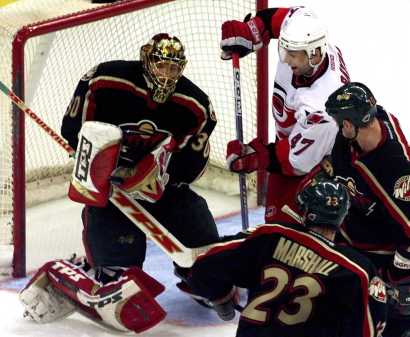
ROLOSON in MINNESOTA Posted by Picasa
ROLOSON in Calgary Posted by Picasa

Monday, May 22, 2006

Here are some photos Richard took of local stencil graffiti.
Freaky graffiti.  Posted by Picasa
Geeky graffiti. Posted by Picasa
Who the @#%* is this, anyway? Looks like Jim Jones to me. Posted by Picasa

Monday night

I'll have to post my Da Vinci Code-related stuff later ... spring cleaning and Richard's nephew visiting tomorrow. Little time to blog. In fact, I need some sleep now. 'Night.

Sunday, May 21, 2006

Sunday

The Oilers just keep on rollin'! It's like The Twilight Zone...

And speaking of the Twilight Zone, David Lynch may have relented by releasing Eraserhead and his short films on DVD, but retained some control by putting a "TV Calibration" guide on both of them... You hafta fiddle with the contrast and brightness to see them the "right way". Directors.

And speaking of directors, I was offered the position of secretary with the local regional one-acts committee, which oversees the regional one-act play competition held here every February (and hosted the provincials this year as well). I start sometime next week, when they hold their provincial post-mortem meeting. Not a prestigious position, but a vital one, and something new for me.

Friday, May 19, 2006

Happy.

The Oilers are actually winning. Believe me, this surprises everyone.

I am a happy camper not so much because of the victory against the Ducks - that just means lots of garbage in the street and grumpy hungover people tomorrow. No, I'm happy because Eraserhead is finally on DVD, along with the short films of David Lynch! He once said he would never allow it to be released on DVD, and the only place you could get one was from Japan. I had a shi**y pirated copy of a pirated copy on VHS, which was slightly less grainy than WWII newsreel footage, but now... DVD! Whoo-hoo!

Also, the heat broke a little. Another reason to be happy.

Thursday, May 18, 2006

Hot.

It is hideously, hideously hot. You'd think summers would be warmish at most, up here in Canada, but no such luck. It's so humid, your feet stick to the floor if you stand still. You set down a glass of cold water, and it condenses so much that within a few seconds there's actually more water outside the glass than in it. My eyelids feel sticky.
Anyway, I'm going to try to get a little sleep. I'll start posting Da Vinci Code-related stuff this weekend...in case you've been under a rock all week, or something. (I'm not going to the movie just yet. I'd rather see Over the Hedge. And at any rate, the provincial one-act festival is this weekend, so I won't be seeing either).

Monday, May 15, 2006

Happy Mother's Day!

A virus prevented me from posting anything for Mother's Day, so here it is a day late! I decided to show you some of the prototypes of the little beaver avatar on my mom's blog, which I have never revealed. Because they're scary. The first picture below is the beaver roughly as it appears today; the pictures below that were rejected for rather obvious reasons.

Anyway, HAPPY MOTHER'S DAY!!
Early beaver drawing. Posted by Picasa
First beaver drawing Posted by Picasa
Carpenter ant. Posted by Picasa